The More Steps, More Care Assumption
A considered grooming routine is not the longest one. Learn to judge each step by fit, comfort and consistency, and keep only what earns its place.
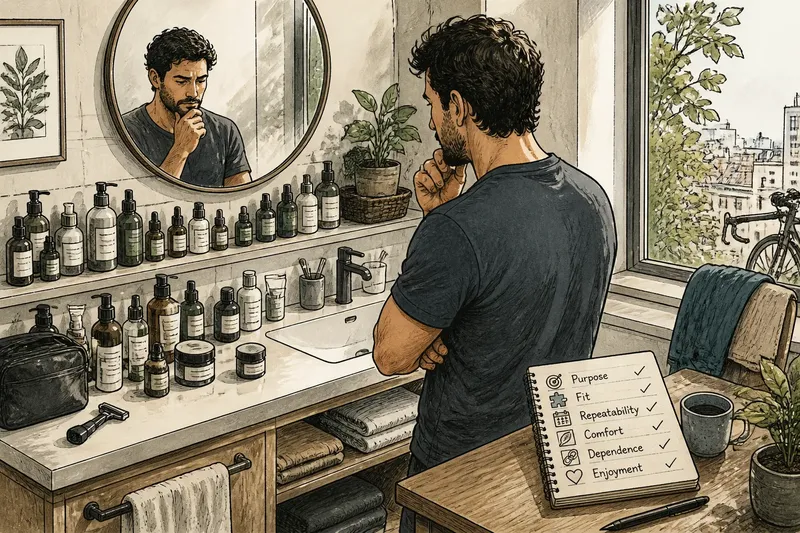
The common mistake with a grooming routine is treating every extra step as evidence of extra care. The cost is not just a crowded bathroom shelf: a routine can become awkward enough to skip, while useful habits get buried beneath optional ones. A considered grooming routine earns its place through fit and consistency, not length.
Care is not a step count
A routine is a sequence of choices, not a scoreboard. Someone who washes their face, moisturises and applies sunscreen before leaving may have a more workable routine than someone layering several toners, serums and creams but often running out of time. The shorter routine is not automatically better, either. What matters is whether its parts answer the person’s actual needs and can be repeated without undue fuss.
Beauty culture often makes visible complexity look like commitment. A row of bottles, a carefully arranged set of tools or an elaborate grooming video can suggest that more effort means better care. But the number of actions says little about whether they suit a person’s skin, hair, schedule, preferences or budget. Products and techniques should serve the routine; the routine need not serve a display of products.
It helps to separate care from ceremony. A calming face massage or a careful beard trim may be enjoyable, and enjoyment is a reasonable reason to keep a step. It becomes a problem only when an optional flourish is treated as a requirement, or when missing it makes the whole routine feel like a failure.
Fit in ordinary life
Fit is practical and personal. A morning routine for someone who cycles to work may need to account for sweat and time outdoors. A person with tightly curled hair may plan wash-day care differently from someone who rinses and styles their hair each morning. Neither routine can be ranked by how many products appear on the sink.
Consistency is not perfect daily repetition. It means a routine has a dependable shape that works through ordinary changes: a late start, a busy week, a different hairstyle or a day spent mostly at home. If one missed optional step makes the rest impossible, the sequence may be too brittle. A smaller core can make it easier to return to familiar care without turning a disrupted morning into a catch-up project.
Picture someone whose current evening routine includes a cleanser, exfoliating product, serum, face mask and several moisturising layers. They find that they often go to bed without washing their face because the full sequence feels like a chore. They could identify the basic action they want to keep, set aside the mask and other optional layers, and see whether a simpler routine feels easier to repeat. The observable change to look for is whether face-washing becomes part of more evenings, not whether the shelf looks more impressive. Any product-specific decision should follow its label and the maker’s directions.
What earns its place?
Before adding a step, ask what it is meant to do. “It is part of the routine” is not a purpose. A step might address a particular grooming preference, make styling easier, protect skin during outdoor activity or simply bring pleasure. Naming the reason makes it easier to notice when the step is redundant, uncomfortable or no longer relevant.
- Purpose: Can you say what this step contributes in plain language?
- Fit: Does it suit your skin, hair, grooming habits and personal preferences?
- Repeatability: Can it fit into an ordinary day, not only an unusually quiet one?
- Comfort: Does it leave you feeling at ease, or does it create irritation, discomfort or pressure?
- Dependence: If you miss it, does a useful basic habit still happen?
- Enjoyment: Do you genuinely like doing it, rather than feeling obliged to perform it?
These are prompts, not a scorecard. A pleasure-based step does not have to justify itself as a clinical necessity, and a practical step need not be glamorous. The useful question is whether the routine reflects the person using it, rather than an ideal assembled from someone else’s shelves or morning schedule.
When should a step stay?
Can an optional step still count as care?
Yes. A grooming ritual can be worth keeping because it feels soothing, expressive or enjoyable. Its value does not depend on being essential, as long as it remains a choice rather than a rule that crowds out the basics.
Does a routine need the same steps every day?
No. Hair washing, shaving or styling may happen on different schedules, and some products are intended for particular occasions. A steady routine can have a simple everyday core alongside occasional steps, rather than requiring the full sequence at every session.
How can you tell a step is not fitting?
Notice whether it is repeatedly skipped, difficult to make time for, uncomfortable or hard to explain. One of these signs does not settle the question, but it gives you a reason to pause before buying another product or adding another action.
Should you keep adding products for a specific concern?
Not automatically. If a skin or hair concern persists, causes distress or seems to be worsening, consider speaking with a qualified clinician or an appropriately trained professional rather than building an increasingly elaborate routine on guesswork.
What is not worth effort
It is rarely useful to copy a lengthy routine simply because a person with different skin, hair, time and preferences can maintain it. Nor does every product need a companion product to feel complete. A matching cleanser, toner, serum and cream may be a coherent range, but matching packaging is not proof that every item has a job in your life.
There is also little value in adding steps to repair the anxiety created by a routine that already feels too demanding. If a product has an unclear role, leave it out while you consider what you actually want from your grooming habits. A brief pause can reveal whether you miss the result, the sensation, the ritual or none of them.
Let the routine change
A routine can change as work patterns, hairstyles, weather, comfort and personal taste change. That does not mean earlier choices were foolish; they may have fitted a different version of daily life. Revisit the sequence when it starts to feel inconvenient, rather than waiting until the bathroom shelf or the schedule feels like a source of pressure.
For a considered grooming routine, the most useful measure is whether each step has a reason and whether the whole arrangement can live alongside the rest of the day. Keep the parts that support comfort, care or pleasure; question the ones that survive only through obligation. A routine with room to breathe is often easier to return to, and that is a more meaningful sign of care than its length.